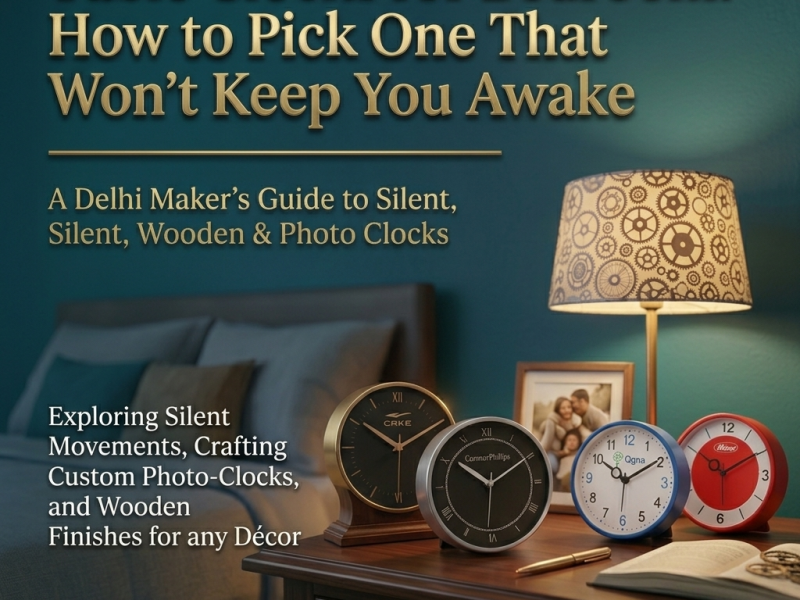
Most people buy table clocks for bedroom shelves in five minutes and regret it for five years. It ticks too loudly at night, or it looks great in the shop and lost in your living room, or the photo you printed on it looks blurry.
We've been making and supplying clocks from Shidi Pura, New Delhi since 1989, and we've heard nearly every version of this complaint. So here's what we'd tell you if you walked into our workshop.
Start With the Room, Not the Clock
Before you look at designs, ask where it will sit and what it needs to do. A bedside clock and a showpiece for a drawing-room shelf are two different jobs.
- Bedroom: you want something quiet, readable in low light and small enough not to crowd the side table.
- Living room: you want something with presence. It should match your furniture and look good from across the room.
Once you've decided, most of the choice makes itself.
What to Look for in a Bedroom Clock
Sleep is the priority here, so a few practical points matter more than looks.
- Go for a silent (sweep) movement. A standard ticking movement seems fine in a shop with background noise. At 2 a.m. it's all you can hear. A sweep movement runs smoothly with no tick, and it's the single upgrade we'd recommend most.
- Keep the size modest. Around 4 to 6 inches across is usually plenty for a bedside table. Bigger clocks look bulky and catch more light.
- Check readability in the dark. Some people like a soft backlight or luminous hands. Avoid bright LED dials, which can disturb sleep.
Think about the finish. Matte and wooden tones feel calmer than shiny chrome or loud colors.
Why a Wooden Table Clock for Living Room Spaces Works So Well
Wood suits Indian homes. It goes with sofas, cane furniture and modern minimal interiors alike, and it doesn't look dated in five years.
If you're shopping for a wooden table clock for living room décor, keep these in mind:
- Look at the wood itself. Solid wood feels heavier and ages well. Engineered wood is lighter and cheaper, but only if it's sealed and finished well.
- Check the polish. Delhi summers are hot and dry, monsoons are humid, and poorly finished wood can crack or warp across these swings. A well-sealed finish is worth paying a little more for.
- Match tones, not exact colors. Your clock doesn't need to match your table. It should sit comfortably next to it, like a walnut clock beside a lighter oak shelf.
- Mind the proportions. On a crowded console, a tall clock looks awkward. On a bare shelf, a tiny one disappears. If in doubt, go one size up for the living room.
A Customized Table Clock With Photo: Lovely When Done Right
This is where most disappointments happen, and where a little care makes a big difference. A customized table clock with photo is a wonderful gift for anniversaries, housewarmings, birthdays or a parent's milestone. But the photo is everything.
- Use the original image. A picture forwarded on WhatsApp gets compressed and loses detail. The original from the phone gallery or camera prints far better.
- Choose the photo carefully. Bright, well-lit photos where faces are clear work best. Avoid photos with tiny faces or busy backgrounds, since the clock face is small.
- Leave space for the dial. Hands and numerals will sit over the image, so pick a photo where the important part isn't hidden behind them.
- Ask for a proof. Any good maker should show you a preview before printing. If they don't, be careful.
- Check the surface. A glass or acrylic cover protects the print from dust and fingerprints.
Small Details That Separate a Good Clock From a Bad One
You don't need to be an expert, but a few checks save money:
- Movement quality. It's the heart of the clock. A weak one loses time within months.
- Battery access. You should be able to change it easily without unscrewing half the clock.
- Weight and stability. A clock that tips over on a slightly uneven table is annoying.
- Finish at the edges. Run your finger along the back and sides. Rough edges tell you how much care went into making it.
Common Mistakes We See
- Buying a large clock for a small bedside table.
- Choosing a ticking movement for the bedroom.
- Sending a low-quality photo for printing.
- Picking a color that fights with the room instead of blending in.
- Ordering a custom clock too close to the occasion. Personalized pieces take time, so give yourself a couple of weeks.
Our Take
A good table clock isn't about being fancy. It's about fitting the room and the person. Pick a quiet movement for the bedroom, a warm wooden piece for the living room, and take the extra minute to get a photo print right if you're gifting.
If you'd like help choosing, message us with your room, budget and occasion, and we'll suggest something practical.
FAQs
- Which clock is best for a bedroom?
A small clock with a silent sweep movement and a soft, non-glaring dial. - Does a wooden clock last in Delhi's weather?
Yes, if the wood is properly seasoned and sealed. Avoid unfinished or cheaply polished pieces. - What photo size should I send for a photo clock?
The original high-resolution image, not a compressed forward. Your maker can advise on the exact size.